Showing posts with label Laos. Show all posts

Monday, April 9, 2018

Luang Nam Tha travel guide, Laos

Nestled in the north of mountainous Laos, just a hop, skip and a jump from the Chinese border, Luang Nam Tha has a remote, cowboy town feel to it but makes an excellent base for exploring the many natural wonders of the province of which it is capital.

Formed by three long, straight and flat roads, the town and its life centres around its two markets. Tourism infrastructure in recent years has improved dramatically here and places such as the excellent Forest Retreat cafe offer fantastic information about the entire region, expanding the options for those looking to forge a trail into the jungle.

Trekking, mountain-biking, rafting and kayaking are among the growing number of ways to enjoy the stunning scenery surrounding Luang Nam Tha. As many argue, tourism here can help send a message to locals that their culture and forests are important and valuable in their own right. Cash you spend on access permits goes to wildlife and forest conservation projects.

Luang Nam Tha itself is home to an ethnic museum, which is worth a pop in if you can find someone to let you in, as well as a small selection of places to buy handicrafts, though you can also explore the surrounding villages for unique finds.

Rent a bicycle to get around town and also to explore the outlying areas. The waterfall at Ban Nam Dee is just a few kilometres outside town and an easy trip using pedal power. More serious explorers should head to the Nam Ha Protected Area, reputed to be home to large mammals such as tigers and elephants (don't hold your breath!) as well as a myriad of colourful birds and frightening reptiles (if you ask us, anyway).

You can take a trip by boat along the Nam Tha River to see some of the area. Guided trips can be arranged by the tourism office. Green Discovery also offers one- or two-day trips along the Nam Tha. For advice and the very latest information, head to Forest Retreat Laos.

Orientation
There are ATMs and money exchange facilities in town and very fast 3G internet through Unitel and ETL but the best guesthouses have free WiFi anyway.

Saturday, April 7, 2018

Don Khon travel guide, Laos

Far larger than Don Dhet, Don Khon is skipped by many budget travellers because most of the accommodation is midrange. However although there aren't 40-odd places to choose from as on Don Dhet, there are budget options here and staying on Don Khon is far more of a Lao experience than Don Dhet.

There is a better range of eateries than on Don Dhet and the options for cycling and walking are considerably more extensive. The main disadvantage or advantage depending on your point of view is that it's quieter and less backpacker friendly, with fewer bars and slightly more expensive food.

The island hosts quite a few reminders left behind by the French -- several old colonial buildings, including the school, the French port and French embankment -- a series of concrete barriers built on the eastern side of the island.

You'll also find what's left of the light-gauge train track that used to traverse the island, now a long clear path of heavy gravel. There's a small engine and a length of the old train track on display to the west of the French bridge.

But Don Khon had a good deal to offer before the French ever showed up, which is still on display -- the powerful Li Phi waterfalls on the western side of the island, the Irrawaddy dolphins off the southern coast and scenes of pleasant village life that you can cycle or wander through at your leisure. It's an idyllic place that balances the excesses of Don Dhet with the idleness of Don Khong.

The accommodation on Don Khon is restricted to a comparatively small portion of the island and the rest is essentially unadulterated Laos.

Orientation
All the guesthouses are clustered at the northern coast of Don Khon, facing Don Dhet. The only other options further afield from here are simple homestays that you'll have to ask around for -- one is signposted down near the old port where tours for the Irrawaddy dolphins depart.

There are no services on the island such as post, police or hospital -- the nearest facilities are on Don Khong and an ATM at Nakasang. Internet is available at Pan's Restaurant and at Auberge Sala Done Khone for free and as time goes by, more and more guesthouses will wisen up to the fact that free WiFi is a strong selling point.

If you cross the French bridge from Don Dhet you'll have to pay 25,000 kip for a ticket that's good for the whole day. The ticket will also get you into the Liphi Waterfalls without having to pay again. The fee represents a tourism tax and perhaps turns away some of the more frugal travellers.

Friday, April 6, 2018

Don Dhet travel guide, Laos

Referred to by some as Khao San Road on the river, Don Dhet is a classic backpacker hub with just a fraction of the shenanigans that take place on Khao San Road. Now well-established on the backpacker trail through Laos, the number and quality of rooms on Don Dhet continues to climb steadily. The scenery is indeed beautiful and the ambience very relaxed, but Laos this is not. Anyone who tells you differently has eaten too many banana pancakes.

If you're on the way here expecting to experience the local culture, prepare to be very, very disappointed. If, on the other hand, all you want to do is relax in a hammock for a week (or a month), meet and talk to travellers and eat traveller food then you're in the right place.

Certainly it's a beautiful area, with daily sunsets and sunrises equally stunning and a wealth of activities on offer – hiking to waterfalls, taking boat or cycling trips, general hiking, camping and extended hammock laying. You could busy yourself here for days or weeks.

You can easily visit nearby Don Khon by crossing the French Bridge, where there are great waterfalls, rusty trains, and the occasional glimpse of an Irrawaddy dolphin.

Electricity arrived in Don Dhet just a few years back and all rooms now at least have a light and a fan. And the fan you will absolutely need as most rooms are extremely stuffy due to the intense heat of the day, which doesn't seem to go away overnight. Especially now that most bungalows come with tin roofs, which compound the issue of the heat. Particularly brutal are the sunrise bungalows in the early morning and the sunset bungalows from about 15:00 onwards.

When we previously visited Don Dhet, rooms were still available for $1 per night. Now, the cheapest you will find is around the $3 per night mark or a little higher, depending on the season. And even these rooms are difficult to find and are extremely basic -- more like camping than staying in a room.

Most bungalows these days are moving toward private bathrooms, but there are still plenty around that share facilities. Overwhelmingly, we found that those with shared facilities offered fairly poor value as they were often priced similarly to those places with private bathrooms.

The accommodation on Don Dhet runs along three sides of the island: the northwest side (sunset side), the northeast side (sunrise side) and the southeast side (facing Don Khon).

For some, this is what travelling is all about. Relaxing by the river, living cheaply and meeting new friends. For others, it's exactly the opposite of what they are looking for. It all depends on what you want from your journey and only you can be the judge of whether this place is a good one or not.

Thursday, April 5, 2018

Pakse travel guide, Laos

Pakse is the provincial capital of Champasak and is one of the most Thai-like towns in all of Laos. Until recently most travellers and backpackers tended to use it as a transit point and little else. Tourism infrastructure here is less developed than the more popular north, making it a bit harder to explore, but Champasak province has much to offer -- and Pakse is an ideal base to explore much of it from.

Pakse doesn't measure up to the low-key splendour of Luang Prabang, but nevertheless it has a definite charm, some beautiful wats and two gorgeous rivers -- great for enjoying some eats and drinks by the waterside and watching the sun smoulder into the horizon.

Pakse in recent times has made a transition from transit point to staging area -- the Lao government has put a lot of careful work into cultivating new, ecologically friendly and quite well-regulated tourist destinations that combine the adventure of exploring the unknown with the convenience of regular and reliable services. You can easily spend a week or so just making daytrips and overnights from Pakse and winding up right back in town to plan the next stage of your journey.

Pakse over the years has become so modern and comfortable for many travelling through Laos that many do now indeed come here to hang out, recharge their batteries and pick up information. And it's easy to do with a decent guesthouse scene, some good food and excellent local hospitality.

The province is best known for the spectacular Khmer ruins at Wat Phu and the stunning cluster of islands near the Cambodian border known as Si Phan Don (4,000 Islands). You'll also find stunning waterfalls rimming the Bolaven Plateau, and you'll get a glimpse into authentic, traditional Laotian life on the island of Don Daeng near Champasak town, making a tour of the region well worth the extra effort.

Travellers should be prepared to spend longer in this province than expected. Besides the excellent hospitality of the locals, there's a growing list of worthwhile things to do. Another reason is the rather slow pace of public transportation. Although Champasak has generally good roads, as in much of Laos the transport that runs along them does so at its own creaky pace, loaded to the roof with more goods and baggage than people, making frequent stops along routes that offer a small selection of daily departures.

Partly as a response to the slow buses, motorbikes have become a popular alternative and are easily rented in the provincial capital of Pakse. For those so inclined, this is recommended, as it will allow you to better explore the province without spending half your time sorting out departure times, waiting in terminals, and languishing on long, slow bus journeys. Increasingly, group package tours offer to take care of some of these hassles for you, but nothing can beat stopping off at a roadside food stall in the middle of nowhere, or coursing down back roads along streams and canals through fields of rice against a scenic backdrop of mountains.

Many backpackers and travellers to Champasak province elect to head straight down to Si Phan Don to while away a few days in a hammock, but for those with more time on their hands, Champasak and Pakse are well worth more than a cursory glance.

Visa
Laos visa on arrival is available at this border and costs the same as every other border crossing into Laos, which depends on your nationality – between US$30 and $45.

Cambodian one-month visas on arrival are available at the Veun Kham-Dom Kralor border for US$20 -- an 'overtime' fee will be levied on weekends, holidays and after 16:30. Of course, Thailand still offers a free 15-day visa on arrival.

Wednesday, April 4, 2018

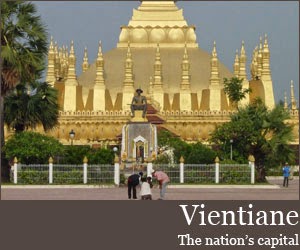
Vientiane travel guide, Laos

The capital of Laos, Vientiane, is a bustling city set on the swirling waters of the Mekong River. For many years Vientiane was a sleepy backwater capital of an equally backwater state, but as Laos has slowly opened up to foreign investment and tourism, Vientiane has gone through vast changes and continues to expand.

But while the Lao capital is now home to a vibrant wealth of hotels, bars and restaurants, it still retains tree-lined dirt roads complete with peaceful temples and relaxed inhabitants. The pace of life, as in all of Laos, is best described as slow -- bordering on glacial. This is still likely to be among the smallest capital cities you ever visit.

Actually pronounced Wiang Jan and translated as City of Sandalwood, the modern name of Vientiane comes courtesy of a bastardised French transliteration. Wiang actually means "fort" (City of Sandalwood sounds better than Fort... ) but by all accounts it mustn't have been much of a stronghold, as the original city was overrun on a number of occasions by the Burmese and Chinese, and absolutely flattened by the Siamese (Thais) in 1828, after which the city was abandoned and left to the jungle.

This is one reason why many of the wats in the city are of a relatively young age, and if the road layout strikes you as an inspired affair, thank the French for it -- they laid the whole place out when they oversaw the rebuilding of the city from the turn of the 19th to 20th centuries.

Like many French colonial cities, Vientiane is characterised by broad, often leafy boulevards and rundown, creaking colonial mansions. Dotted with rustic wats surrounded by coconut palms and a generally sedentary pace of life as well and the allure of the place can be well understood.

Indeed it's only since the early 1990s that the city has really started to develop. While it's a shame that the first waves of (largely Thai) investors that hit landlocked Laos brought with them the concrete egg-carton style architecture that litters so much of Thailand, at least the riverfront, with its sleepy wats and broken pavements, didn't bear the brunt of it.

So while Vientiane may lack the overwhelming charm of Luang Prabang, it still has enough sights and attractions to hold a traveller's interest for a few days, and with an international airport and an easy overland route into Thailand, this remains one of the primary gateways into Laos. Many choose to rush through, spending little more than a night in town while awaiting a visa or onward connection, but as with most Lao destinations, a longer stay can be rewarding.

For a capital, Vientiane isn't exactly overloaded with museums and sights, but in a way that's part of the attraction. Slow down to Lao speed -- hire a bicycle; see one or two things a day; spend a lot of time snacking and quenching your thirst by the river. You'll grow to appreciate the attraction of the place.

While you'd expect the flow of the Mekong to attract guesthouses and hotels by the truckload, the road along here, Fa Ngum, has fewer places to stay than you might expect. Plenty of other choices line the roads leading off it but few really take advantage of the views.

Vientiane also boasts a great selection of Lao and Western restaurants and cafes, and an eclectic mix of sights and attractions which can be combined well for a comfortable two- to three-day stay. Whatever you do, before you move on, don't miss a riverside sunset in Vientiane.

North of Vientiane lies the backpacker and independent traveller magnet of Vang Vieng -- a village that became a tourist town in way too short a period of time. The state of the place became such a debacle that other regions in Laos used Vang Vieng as a model of exactly how they didn't want their own locales to develop. But all that changed in August 2012 when the central government cracked down on illegal bars lining the river and shut the lot down, effectively curbing the outrageous behaviour that went along with them.

Now that the party in Vang Vieng is over, all that is left is the scenery, picturesque rivers, jagged cliffs and mysterious caves -- there is a wealth of natural beauty here just waiting to be explored. The town itself is still a little soulless, but no hotel or guesthouse is more than a five-minute walk from wonderful rice fields and spectacular scenery.

There is more to Vientiane's surrounds though than just Vang Vieng: Nam Ngum dam, Lao Pako and the sculpture garden to name but three. Look around a bit and chances are you'll find something interesting.

Tuesday, April 3, 2018

Vang Vieng travel guide, Laos

Situated halfway down the long Vientiane to Luang Prabang highway, Vang Vieng has become the pit stop of Laos. Surrounded by splendid karst scenery and overflowing with activities such as caving and tubing down the river, many weary travellers extend their stay here far longer than originally planned.

Until recently, Vang Vieng was the highlight of many people's trip to Laos. Scoffing happy pizza and quaffing buckets of lao-lao and coke to a background of infinite Friends episodes was the thing to do when in town, but now things are different. A government crackdown on illegal bars lining the river has severely curbed the party such that fewer backpackers of that ilk are visiting town, leaving the area to those more interested in enjoying the area's immense natural beauty.

For the party people, this was a multi-night and even multi-week stop on their itinerary through Laos while for everyone else it was more like a one-night stop. The opposite is now true, with people seeking a party staying for a couple of nights before deciding that the atmosphere is not as it once was. For everyone else, the true beauty of the area is being well and truly explored and a more laidback and peaceful vibe is in the offing.

Vang Vieng is riddled with such an array of guesthouses (some of which can be booked online), restaurants and shops that it's hard to know what to do on arrival. Just about every shopfront on the main streets of this small but rapidly developing town caters to the tourist dollar. If you're looking for some genuine Lao culture, Vang Vieng is the wrong place.

The reason this tourist mecca has sprung up is the gorgeous Nam Song river and the magnificent karst mountains lining it. The imposing limestone structures rise up out of the land and run for kilometres, framing the rice fields and lazy river. Though stunning at any hour, the mountains are particularly beautiful with the golden pink glow of sunset behind them, the perfect time to sit and have a drink at one of the plethora of riverside restaurants.

For action and adventure, there are caves to explore, trekking, kayaking and rafting trips and, for the ultra-adventurous, rock climbing. To chill out and enjoy Vang Vieng's scenery, rent an inner tube and float down the Nam Song basking in the beauty of the countryside – an activity for everyone these days.

This place is not Laos untouched, but just outside of the town you will find a peaceful version of Laos that has been overlooked for far too long.

Orientation
Vang Vieng has BCEL ATMs scattered throughout town. The fee for international withdrawals is 20,000 kip and you can withdraw a maximum of 1,000,000 kip each time. A better option is the Joint Development Bank ATM down near the tubing shops as it has no such withdrawal fee. Guesthouses and tour agencies throughout town will do money exchange at fair rates but it certainly pays to compare rates.

The Vang Vieng Municipal Hospital is opposite Ban Sabai bungalows on the road running along the river. They can patch up minor ailments, but for anything serious you'll want to get to Thailand or at least Vientiane ASAP.

Internet cafes throughout town are less popular than they once were as almost every single hotel offers free WiFi with many offering free use of their computers. Even the cheapest hostels and guesthouses offer free, reliable WiFi internet.

Hobo Maps distribute an excellent map of Vang Vieng.
Hospital: (023) 511 604

Thursday, February 26, 2015

Muang Ngoi travel guide, Laos

A gorgeous, sleepy town, Muang Ngoi gets our vote as one of the friendliest places in all of Laos. You won't find any banks, public internet access or landline telephones, so remember to bring cash and tell your friends and family you'll be incommunicado. However, given the pace of development around Laos, it is only a matter of time before the modern world arrives in Muang Ngoi.

The town is home to about 800 people and has a small school and a temple. Limited electricity means that the locals' lifestyle is aligned with daylight hours, and the town shuts down by nine or ten at night and wakes up with the noisy roosters at daybreak (or actually, a little earlier...).

While the locals are genuinely warm and welcoming, they're also eager to cash in on the tourists flocking to their tiny town. Some locals may persist in offering you their services as a trekking guide, but they're just as likely to invite you to join them for a game of sepak takraw or petanque.

Smaller than Nong Kiaow, Muang Ngoi offers a similar scope of activities that makes the most of the area's natural beauty: trekking, boating, caving, camping, kayaking. Nearly every guesthouse can arrange a tour with a local guide, but Lao Youth Travel is the most reputable spot.

Almost all the guesthouses wisely have hammocks on their balconies, and the favourite pastime of most visitors is simply swinging and appreciating the view.

Directly in the path of the Ho Chi Minh Trail, the area was quite heavily bombed during the war and locals lived in nearby caves to avoid the falling bombs. Some of these caves can now be visited on treks and it's less than an hour's walk to Tham Kang and Tham Pha Kaew caves, which are best appreciated with the knowledge of a guide. Keep your eyes open around town for war leftovers as a few guesthouses decorate their grounds with bomb casings.

Whether you only have a few days to spare and want to get out of Luang Prabang, or want to use these places as a stepping stone to a more in-depth exploration of the north, Nong Kiaow and Muang Ngoi are both great destinations.

One warning though. Over the last couple of years there have been persistent reports of theft from bungalows in Muang Ngoi. We'd suggest you're best not to leave anything of much value in your shack.

Lao Youth Travel: Near the boat landing, http://www.laoyouthtravel.com, (071) 253 340

Luang Prabang travel guide, Laos

The northern province of Luang Prabang and its eponymous capital are among the most atmospheric and popular destinations in Laos. The charming city of Luang Prabang, once the capital of Laos and still considered to be its spiritual heart, breathes a rich meld of French Indochinese architecture, Theravada Buddhist temples and a magical atmosphere.

Luang Prabang is strikingly situated on a peninsula formed by the confluence of two rivers, the Mekong and the Khan. Its palm-lined riverbanks, terracotta roofs, golden stupas and saffron-robed monks all come together to form a picture postcard increasingly difficult to find in Southeast Asia. Somnambulant and languid, its peaceful feel masks a history of conquest and recapture, and only hints at the intricate culture and traditional rituals that still take place here every day.

Declared a UNESCO World Heritage site in 1995, the town was described by the global body as "an outstanding example of the fusion of traditional architecture and Lao urban structures with those built by the European colonial authorities in the 19th and 20th centuries. Its unique, remarkably well-preserved townscape illustrates a key stage in the blending of these two distinct cultural traditions."

The city has been considered one of Southeast Asia's must sees for nearly two decades now, so untouched it's certainly not. However, the city has a newfound popularity with older travellers and families seeking an exotic yet safe holiday, and prices are on the rise. With an international airport and daily connections to Thailand, Cambodia and Vietnam, many people fly in and fly out and see nothing more of Laos. This means more foreign visitors per temple than perhaps anywhere else in the region (except Angkor Wat), so rein in any expectations of having the place to yourself.

With the influx of tourists, local families have en-masse converted their family homes into guesthouses. House after house on street after street have found new lives as guesthouses and while this is a boon for those wanting a comfortable stay in Luang Prabang, it also threatens the very thing that made Luang Prabang so charming in the first place. In some parts of the town, it can feel a little bit like Disneyland, with tourist-focused shops, hordes of camera-toting tourists and a certain fabricated feel that some won't notice and others will despise.

A simple walk about town illustrates Luang Prabang's charms. It's picturesque, with all the charm of a quaint European town mixed with the wonderful, woodsy spice of Asia. A popular pastime is simply lounging in a quiet cafe with a baguette and coffee (Laotians drink the real stuff, not espresso) and watching local life pass by.

With an outstanding range of restaurants, guesthouses, luxury resorts and hotels, a gorgeous location and friendly people, Luang Prabang has a reputation for wrecking tightly planned itineraries. Be sure to allow at least a few days to really take this wonderful town in.

Sleepy much of the year, Luang Prabang bursts with life during Pimai Lao, Lao New Year. If you're planning on visiting at this time, be sure to book a room well in advance.

With the capital at its centre, Luang Prabang province stretches north to Phongsali and the Vietnamese frontier, east to Hua Phan and Xieng Khuang, south to Vientiane and west to Udomxai and Sainyabuli.

The east of the province in particular is a vast, mountainous swathe of real estate with next to nothing in the way of development, but to the north you'll find the villages of Nong Kiaow and Muang Ngoi, laidback, stunning riverside spots attracting a steady backpacker trade and increasingly tour groups heading out of Luang Prabang. Both can be reached by road and if you plan on striking north to Phongsali, you'll definitely want to set aside a day or two in one or the other, or both.

Monday, February 9, 2015

Don Khong travel guide, Laos

The largest island in the Si Phan Don area, Don Khong is nowhere near as popular as the more southern islands of Don Dhet, with its chilled-out atmosphere, and Don Khon which has more activities on tap. The interior of Don Khong is almost entirely given over to rice cultivation and a forested mountainous area, while just about all the accommodation is crammed into and around the sleepy town of Muang Khong, which is situated on the east coast of the island.

The major pastime on Don Khong is cycling around the countryside. Both in the early morning and late afternoon when temperatures are reasonable and the light is golden, this is an excellent way to pass a few hours, though it's best to avoid the middle of the day when the heat is oppressive.

There are a few small villages scattered around the island's edge along with some interesting little temples and pleasant riverside scenery, and those with the time and money could probably get someone to arrange a trek or two, but overall the main attraction here is the gentle pace of life.

Another option is to ride eight kilometres west to Muang Sen, where there's a marketplace and some wonderful riverside views which are fantastic at sunset.

Other options from Don Khong include trips that are easier to stage from Don Dhet but worth it if you're only staying on Don Khong. You can always visit Don Khon on a daytrip and visit the Li Phi Waterfalls as well as seeing the Irrawaddy dolphins and the remains of the old French railroad.

Orientation
Most independent travellers arrive in Don Khong via the main boat landing, which is near most of the guesthouses and restaurants, on the east side of the island. A boat landing four kilometres south capable of carrying vehicles is due to be replaced by a large bridge in early 2014.

Most guesthouses on the island now offer free WiFi and the odd one has shared computers available for use. 3G internet is available via Unitel.

You can exchange money at the Agricultural Promotion Bank on the main road heading south past the wat with the big Buddha. Open weekdays only.

A BCEL ATM is located on the road to the other side of the island, about 300 metres from the boat landing and close to the wat.

Huay Xai travel guide, Laos

Capital of Bokeo province and the northern gateway to Laos, Huay Xai is the most popular entry point to Laos from northern Thailand. Once a big opium shipment centre for the Americans during the war, the town now busies itself moving people rather than narcotics -- and what a fine job it does.

The border crossing is officially known as the Chiang Khong/Huay Xai crossing and the two towns face each other across the Mekong's waters, with travellers crossing between the two countries by boat. Many people choose to stay overnight in Chiang Khong on the Thai side, but Huay Xai is a good enough spot for a night. It's also a good place to ease yourself into Laos, particularly if Pakbeng is to be your next stop.

If you're concerned about missing the slow boat if you sleep in Chiang Khong and cross the border in the morning, don't worry -- as long as you drag yourself out of bed at a reasonable hour, you'll be fine as the border opens early and the slow boat may leave as late at 11:30.

Huay Xai has a bunch of guesthouses and some restaurants that more than adequately cater to tourists' tastes and many have information about travelling through northern Laos. However their main pre-occupation is trying to sell you a ticket on the slow boat to Luang Prabang -- because the vast majority of people who cross into Laos at Huay Xai leave as soon as they can.

It's not that there's anything wrong with the place, but there's not really all that much to "do" in town itself. Fort Carnot is on the hill -- it was built to house the French Foreign Legion, but during our last visit was under renovation after a period of time as a Lao army barracks. Then there is the mandatory wat in the centre of town which is nice enough but only worth a visit if you are particularly curious about temples.

However, if you choose to hang around, there are plenty of opportunities for more adventurous travellers to explore Bokeo. While the province may be small it is mountainous, and for much of its border these mountains run into the Mekong River -- the scenery is spectacular -- and it makes up for its diminutive size with more than a couple of places worth investigating.

A couple of travel agencies in town also offer day trips visiting local ethnic minority villages, but there is also scope for roll-your-own explorations. The riverside villages of Pak Tha, and Pak Hat to the south (both on the Nam Tha River) and Nam Nyon waterfall to the north are all worth a peek if you have the time -- and have a good phrasebook packed.

More intrepid travellers may want to consider a jeep trip from Pak Hat to Pha Udom which passes through some spectacular scenery. It's also possible to travel from Huay Xai upriver to Xieng Kok, but in recent years it has been a more do-it-yourself affair as speedboats have been refusing to carry passengers due to some shootings. The best bet is to wait at the slow boat dock's immigration office for a passing cargo vessel heading up river.

Then there's the Gibbon Experience -- an environmental protection programme with a difference -- it forms the highlight of many traveller's time in Laos.

Despite all this, the majority of travellers crossing into Laos at Huay Xai head down the Mekong River to Luang Prabang via Pakbeng, or jump on transport to head up Route 3 to Luang Nam Tha and beyond -- whatever you choose to do, Huay Xai will sort you out.

Sunday, February 8, 2015

Laos_Relax

Landlocked Laos is one of the Asia's most enchanting destinations. Stunning natural beauty -- think mist-shrouded mountain peaks flanked by jungle-clad valleys teeming with wildlife -- combine with a fascinating Buddhist culture to make Laos a superb destination for backpackers and independent travellers, while luxury tourists are now also well-catered for.

Communist Laos flung open its doors to tourism in the early 1990s. The last decade has witnessed an explosion in development as businesses -- some Lao, some foreign -- mushroom to cater to the swelling crowds.

Laos is changing fast, but pockets remain well off-the-beaten-track, ready to be explored by adventure travellers willing to forego the usual tourist luxuries. Those who want to experience a real taste of rural Southeast Asian life will be delighted.

Laos attracts many travellers who consider northern Thailand to now be over-developed or "touristed out" and are looking for places less inundated with foreigners.

Ironically, most of these tourists still stick to a now well-trodden path through the Land of a Million Elephants -- though even these destinations retain an allure little diminished by the crowds.

Incredibly romantic Luang Prabang should be considered a must see, with its glittering temples, saffron-robed monks, and sleepy riverine lifestyle. The pace has moved up a notch since the tourists have arrived, as slick cafes jostle for space with chic boutiques showcasing the best Laotian wares: intricate weavings, elaborate silver trinkets and speciality foods.

The bustling capital Vientiane tempts many, as does the thriving tourist centre of Vang Vieng. We'd actually suggest you skip the latter -- a heaving backpacker hub -- but the limestone crags and riverside scenery remain gorgeous despite the mass of travellers.

For the independent traveller, those are just the standard spots to tick off the list, with plenty more to be discovered.

The far northern provinces of Phongsali, Luang Nam Tha and Udomxai offer exciting possibilities for independent trekking. The industry is fledgling and infrastructure is still developing, so trips tend to be challenging but infinitely rewarding. In the mysterious northeastern Plain of Jars and north to Hua Phan, you're in the midst of what was Pathet Lao heartland -- an area that the United States tried to bomb back to the stone age and which, 30 years later, is still trying to get back on its feet.

The far south of Laos is also slowly emerging as a trekking centre. Although many shoot straight down to Si Phan Don, hanging out on Don Khong, Don Dhet and Don Khon for a taste of lazy island life and a spot of dolphin watching. There is a lot to see and experience in between for the more intrepid. Tha Khaek and Savannakhet offer nascent trekking and caving, while Attapeu, Pakse, Champasak and Salavan are all worthy spots to while away a few days exploring.

Destinations aside, Lao food also entices. Spicy meat salads, sticky rice, noodles, curries and fish tempt right alongside culinary remnants of French colonial occupation. Crunchy baguettes stuffed with pate and salads are standard market fare, while upper-end French restaurants offer delights at astounding prices. And of course, ice-cold Beerlao -- considered Asia's best by some -- is stocked right across the nation.

Share

Twitter Delicious Facebook Digg Stumbleupon Favorites More